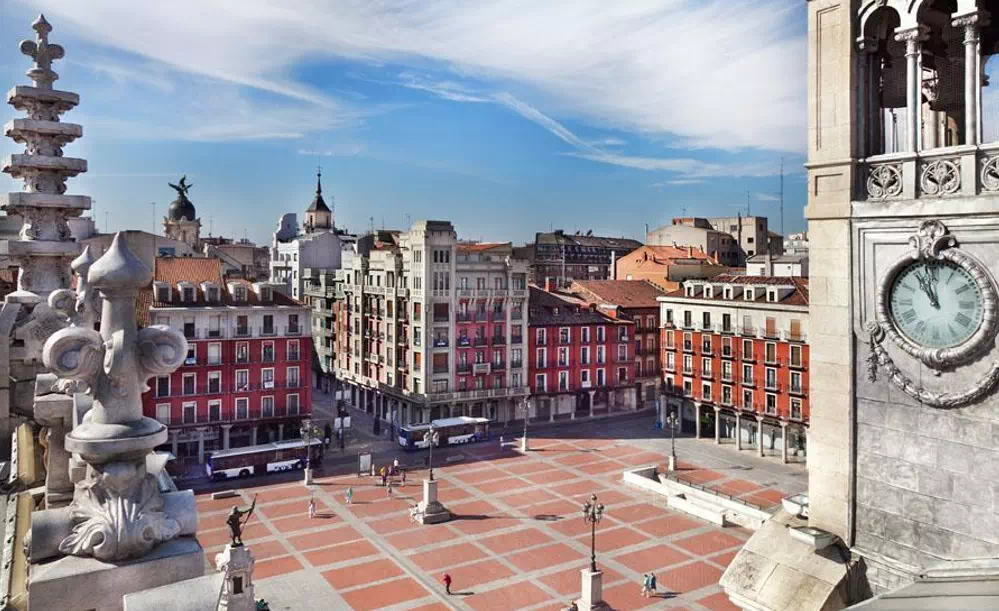
Valladolid city’s main square | Source: Valladolid team
A Region Taking Climate Action to the Next Level
Located at the heart of Europe, Castilla y León faces the growing challenge of adapting to climate change from a uniquely complex territorial perspective. As one of Spain’s largest regions, Castilla y León combines geographical diversity with a largely rural, ageing, and dispersed population, factors that shape both its climate risks and its capacity to respond.
In this context, climate adaptation is understood as a cross-cutting challenge that affects production systems, infrastructure, ecosystems, public services, and social cohesion alike. Responding to these interconnected risks requires integrated, multi-level, and long-term approaches capable of strengthening resilience across sectors and communities.
This vision is at the core of Castilla y León’s participation in the Pathways2Resilience (P2R) programme. Through the initiative, the region is developing a Regional Climate Resilience Strategy designed to guide strategic decision-making and establish a coherent framework for progressively advancing climate resilience.
The strategy builds on a comprehensive baseline report developed and validated within the P2R framework. This assessment has enabled the region to identify in detail its main climate risks, territorial vulnerabilities, existing capacities, and governance mechanisms, providing a strong evidence base for future action.
Beyond the technical work, P2R has also helped drive an important institutional and cultural shift. In Castilla y León, climate adaptation is no longer viewed simply as a plan on paper; it is increasingly becoming a coordinated and collective effort. The programme has provided not only a methodological framework, but also a shared direction that is helping institutions and stakeholders align their efforts more effectively.
For a region defined by territorial diversity and demographic challenges, this transition represents a significant step forward. By moving from scattered initiatives toward a more structured and ambitious resilience approach, Castilla y León is laying the foundations for a more adaptive, connected, and climate-resilient future.
One Consortium, Many Voices
At the heart of this transformation is the ADAPT2CYL (Adapt for Castilla and León) consortium. It brings together the Natural Heritage Foundation of Junta de Castilla y León, the City Council of Valladolid, and the Provincial Council of Valladolid, bridging different levels of public administration, alongside the AEICE Cluster, representing the private sector.
What makes this collaboration stand out is its alignment. Different actors, with different roles, are now working toward the same goal: strengthening climate resilience across the region.
In the process, local strategies have been connected with regional and European objectives, creating a more coherent and unified response to climate change.
Before P2R, coordination between regional, provincial, and local levels was limited. Climate considerations were not always integrated into budgets or funding decisions. And at the local level, technical capacity to implement adaptation measures often fell short.
These gaps are now clearer, and that’s part of the progress. Recognising these barriers is helping shape the next phase: one focused on stronger coordination, better integration of climate into decision-making, and more support for local administrations.
From Plans to Real Change
What makes P2R different is how it works. Rather than focusing on isolated actions, the programme promotes co-creation and collaboration across levels of governance. It connects local experience, like Valladolid’s Climate Strategy and Mission City commitments, with broader regional planning.
The result? Climate adaptation is starting to move beyond analysis and into real, sustained implementation. It’s not just about producing reports. It’s about building the institutional and governance foundations needed to act on them.
The project’s budget has been a key enabler, not only for delivering technical outputs, but for bringing people together. It supported the development of core deliverables, including a climate risk assessment, an adaptation strategy, and an investment plan. But just as importantly, it made space for dialogue.
Workshops, citizen engagement activities, communication campaigns, and the final project event all helped build awareness and momentum. The involvement of sector-specific experts added another layer of value, strengthening technical quality and supporting capacity-building.
One concrete result: a climate risk guide for the habitat sector, turning knowledge into a practical tool.
A Shift That Matters
One of the most important changes has been the move from fragmentation to structure. What was once a dispersed landscape of initiatives is becoming a more coherent and politically supported framework for climate resilience.
Stakeholders from across sectors have played a central role in this shift. Their participation has helped identify risks, co-design solutions, and shape the Regional Climate Resilience Strategy. At the same time, a stronger ecosystem of collaboration is emerging, one that connects public authorities, businesses, and other key actors.
So, what made collaboration work? Regular meetings, co-creation workshops, and capacity-building activities helped maintain alignment, strengthen participation, and build trust among partners. The shared Pathways2Resilience framework also provided a common language and structure for collaboration across governance levels, keeping efforts consistent and focused. What truly sets ADAPT2CYL apart is its ability to bring together different governance levels and the private sector in a genuinely integrated way.
Looking Ahead: A New Phase Begins
The end of the ADAPT2CYL project is not the end of the journey. It marks the beginning of a new phase, one focused on implementing the Regional Climate Resilience Strategy and strengthening the systems that support it.
The coming years will be crucial. Continued investment, learning, and collaboration will determine how far the region can go in building long-term resilience. What is clear already is that the foundations are in place. And for Castilla y León, that changes everything.
“The added value of the participation of the region of Castilla y León in P2R is the development of a multilevel strategy, which involves the coordinated work of 3 territorial levels (regional, provincial and local), with their corresponding public authorities and their economic and social ecosystems. Territorial and sectoral coordination is essential to achieve a global, inclusive vision of adaptation to climate change.”
Jesús Díez. Director de Programas. Fundación Patrimonio Natural de Castilla y León